Listen to this story:
0:00
/
Finding creative ways to keep early-career researchers in academia—for example, through part-time roles—can help the field weather the storm.
To say that the current funding climate in academia is uncertain would be an understatement. Between the drastic ongoing changes at the U.S. National Institutes of Health and National Science Foundation, along with broader anti-science rhetoric that has continued to emerge in the United States over the past year, scientists are legitimately questioning the future viability of the field. Because of the NIH bill passed in February that allows for multiyear funding, fewer labs will be getting grants. And these funding uncertainties mean that many researchers will need to close their labs or at least be unable to accept new members. Graduate programs in neuroscience, too, are understandably wary of taking in a large incoming class in the fall of 2026.
The shrinking pipeline for training academic scientists is matched by a parallel issue: fewer available tenure-track faculty positions. The oversaturation of Ph.D.s in the academic job market is not new—indeed, much ink has already been spilled on the topic. The grim reality is that only a small fraction of Ph.D.s manage to secure tenure-track faculty jobs. Unfortunately, the problem is only getting worse.
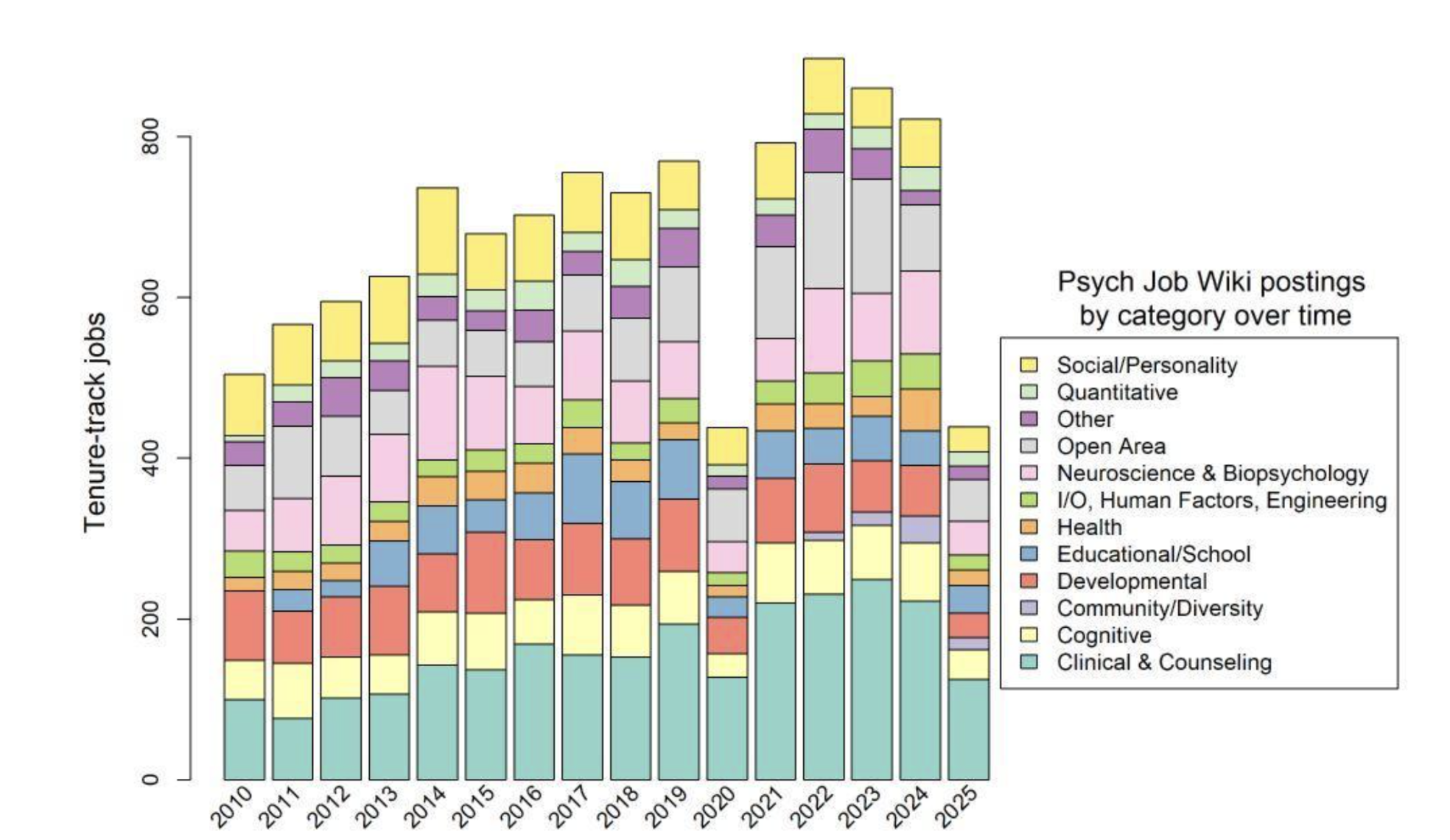
In the fall of 2025, Mark Thornton, assistant professor of psychological and brain sciences at Dartmouth University, started posting analyses of tenure-track faculty jobs in psychology and related fields on social media to help early-career researchers gauge the status of the academic job market. The numbers are alarming and suggest a drop in faculty hiring in 2025 as large as that seen during the first hiring cycle of the COVID-19 years in 2020. Even worse, neuroscience and biopsychology faculty positions, shown on the chart in pink, seem to have taken a particularly large hit, with about 4 percent fewer positions than in 2024.
Right now, in the face of these grim realities, many academic scientists are starting to lose hope. Still, I believe there are ways to make sure the academic pipeline does not completely dry up. We must think creatively to keep early-career scientists afloat while we collectively weather this storm.
P
Several of my own former trainees who have successful careers in industry still “dabble” in academia through their part-time roles in my lab. One of my former Ph.D. students provides statistics consulting for current graduate students on an as-needed basis and conducts high-level analyses of neuroimaging data for us from time to time, continuing to co-author manuscripts. A former lab manager who has since completed a Ph.D. and postdoctoral work now spends 50 percent effort as a project scientist, assisting us with data collection and helping graduate students with data analysis and manuscript preparation. Another statistics consultant in our group, who is a data science manager at a major consulting firm, publishes first-author papers every year in his “spare” time! All of these scientists would be strong candidates for faculty positions were they to decide to return to academia in the future.
Many labs have faced difficult staffing decisions during this austere funding climate. Some, including mine, have increased the use of “shared” positions across multiple research groups. For example, we have a project coordinator who spends half of her time in our lab and half in another doing the same type of participant recruitment work for both studies. Postdoc splits are also common between research groups that no longer have the resources to support one entire position.
If we want to ensure that academia does not lose all of its young talent during this period of funding scarcity, we must continue to come up with creative and flexible paths for early-career researchers to stay involved with the field. We will get through this by patching the pipeline together.